At Least It's Not Grey Blocks Anymore
This game still doesn’t have a name. You can help with that — the naming poll is on the project page.
I’ve never really done anything with graphics before. That’s worth saying upfront. So when I first got a circle to render — just a circle, just sitting there on screen — I was genuinely impressed. That was the moment. Not a spaceship. Not a solar system. A circle. And then another circle for a planet, a slightly different colour. That was it, and it felt like something.
We’re past that now.
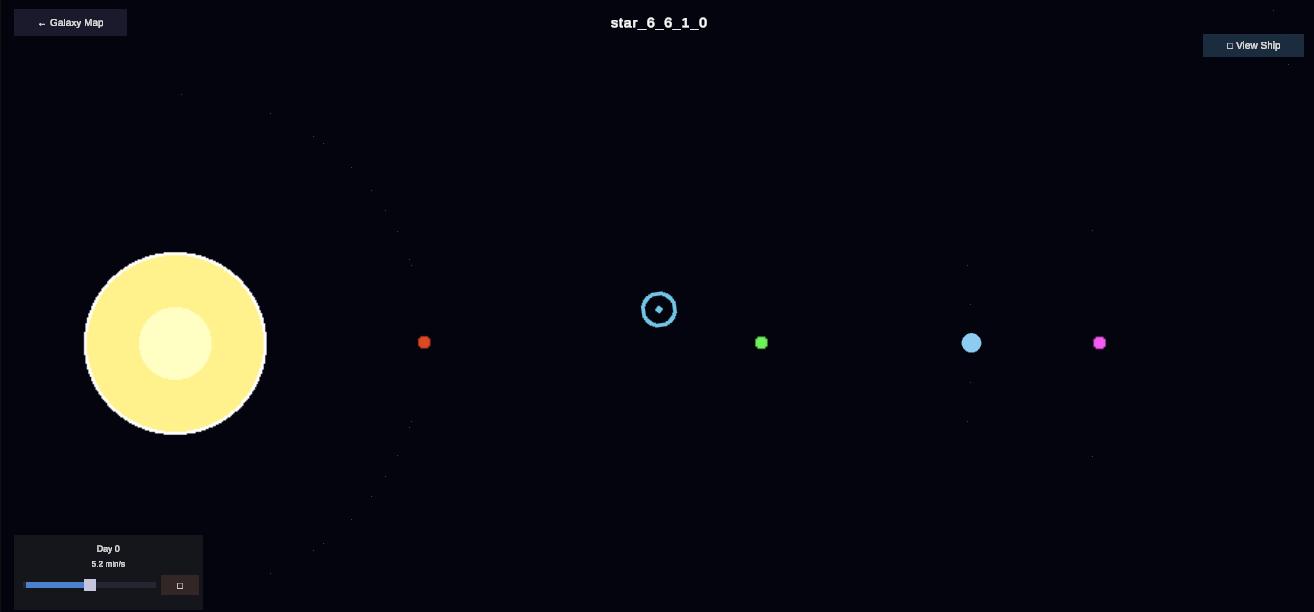
That’s a procedurally generated star system — star, orbital bodies, their distances and sizes all computed at runtime from a seed. And this:
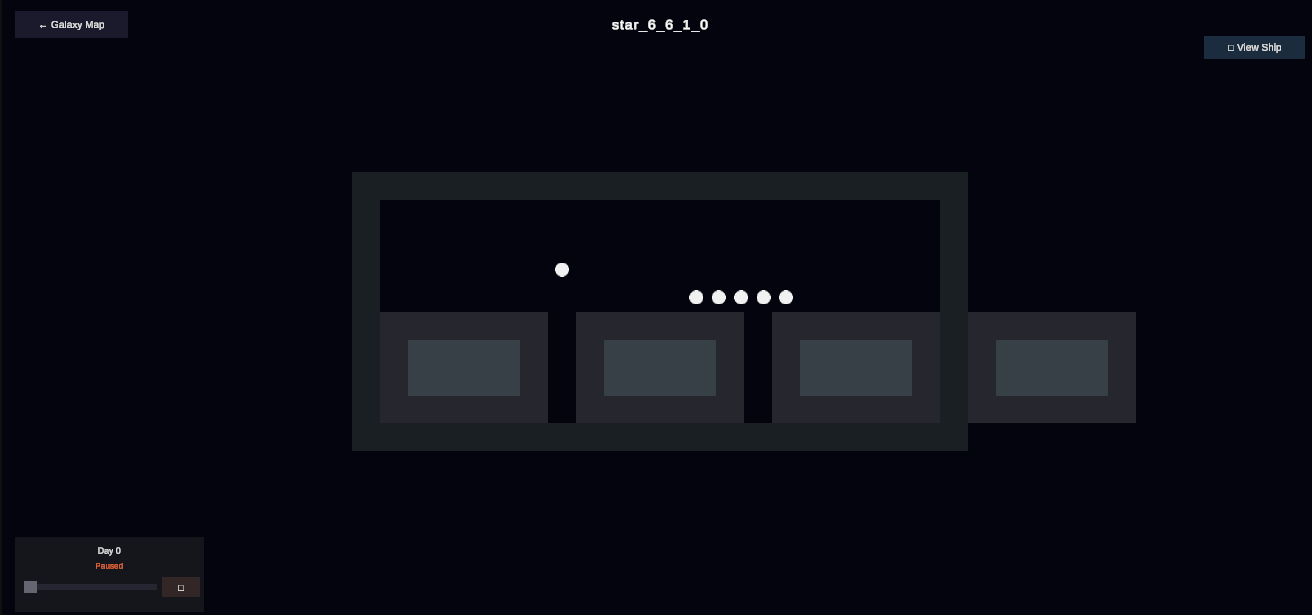
That’s the new ship interior, built from a layout generator as of this week. It’s supposed to be showing a texture. It isn’t. That’s fine, this is new new. I’ll figure it out.
Procedural everything, because the alternative is unhinged
The star system layout is done dynamically. The ship layout is procedural. Almost everything you see in those screenshots is generated at runtime from a seed state, not hand-authored. That’s not a flex — it’s a survival strategy.
The honest version: I absolutely will not hand-author thousands of individual assets. Not won’t. Can’t. You cannot trust me to do the visual art. If this game is going to have a living, populated universe with interesting geology and destructible constructions and weird biology, then the system has to generate it, because I’m not.
The goal is to spend my time thinking about how to procedurally generate assets when they’re needed, rather than building a library I’ll never finish. Picking up the right tools and techniques slowly, figuring out how they fit together, and building the rules that generate the world — not the world itself.
Digable geology and destructible constructions
The vision for the planetary surface layer includes geology you can actually interact with — mine it, build into it, have it matter. And construction that breaks. Things that were built by someone and can be unbuilt by someone else, or by entropy, or by whatever walks out of a cave.
The ship generation is the first real proof-of-concept that the “build worlds from rules” approach works at a structural level. Templates that produce layouts that produce spaces with rooms and corridors and places where things happen. The crew dots you can see in the interior view are finding their rooms. It’s very early. The grey rectangles you’re looking at are the rooms. At least they aren’t grey blocks anymore.
Getting genuinely weird with the biology
There are already type tags in the codebase for things that aren’t humans or aliens in any conventional sense: hybrids, synthetics, fungi, and just — exotic. That last one is doing a lot of work.
I want Star Trek moments and Event Horizon moments in the same game. Or, to put it more accurately: At the Black Hole Observatory of Madness. The planet generation should naturally produce Alien situations. Not through scripting — through the emergent logic of what happens when you procedurally generate a biosphere and then send a crew into it with incomplete information.
Completely random flora, fauna, and things in between and other. I’m still figuring out how to handle the “other” part. That’s arguably the most interesting part to figure out.
Where this is actually going
This is an exploration. Every piece of representation — every circle that shows up in the right place, every ship layout that isn’t total chaos — is new territory for me. I’m iterating slowly on how to display things and picking up assets over time, thinking about how each piece fits into a procedurally coherent whole.
It’s a struggle. But it’s moving forward. And that ship interior is not grey blocks. That counts.